|
Seattle 4/7/2001 | Legendary
director Peter Brook's new adaptation of Hamlet—which
I caught on opening night in Seattle, the first stop on its
international tour—lives up to its advance billing as
the must-see event of 2001 for Shakespeare and theater enthusiasts
around the world. Be sure to see it if you can when it stops
at the most convenient city—Seattle, New York, Chicago,
Vienna, Tokyo, Kyoto—for you.
Brook distills Hamlet to its essence, leaving only
as many words as can be fully comprehended in a little over
two hours traffic onstage, without intermission. This allows
his hand-picked crew of 8 world-class actors, led by a dreadlocked
Adrian Lester as Hamlet, to concentrate on what a Brook production
does best: bringing Shakespeare's characters to life through
the language their creator has given them with absolutely
breathtaking verisimilitude.
What Brook said in response to a question in a public lecture
at Seattle's Town Hall a few days before opening night—that
Shakespeare's words are exactly what this character would
say if they could express themselves perfectly, using all
the resources of language at their disposal, in a perfect
improvisation—he made good on in performance. If Hamlet
had been born Adrian Lester, this is exactly how he would
have said the lines attributed to him by Shakespeare, no doubt
about it.
Every word communicating a full awareness of its manifold
meaning, replete with nuances responsive to nearly every latent
possibility of the text, stroke upon stroke of artfully layered
representation: that's the kind of picture Lester painted
of Hamlet in phrase and gesture. Yet there was nothing showy
or strained about it, just the modesty of a master artist
making the difficult look easy—the most natural thing
in the world. And the happy few that accompanied Lester in
this production—most notably Bruce Myers as Polonius
and the Grave Digger, Naseeruddin Shah as Rosencrantz and
the First Player, and Brook's wife Natasha Parry as Gertrude—all
performed at a similarly stratospheric level of accomplishment—or
at the very least, Everest-high.
That's why this production is a must see: when every moment
approaches so nearly to perfection, how can a poor critic
like me possibly tell all? You just have to witness it yourself.
Still, I suppose I can mention a few highlights.
The power of Lester's Hamlet is apparent upon his first entrance,
when (thanks to Brook's rearrangement of the text) he delivers
his "O that this too too sullied flesh" monologue
as an unmotivated, admirably dispassionate assessment of the
situation—not the typical adolescent cri de coeur provoked
by anger at Claudius's paternalistic advice to move beyond
grief, which usually comes before. Or again, after his encounter
with the Ghost, when he leaves no doubt of the complete control
he's capable of exerting over his performance, even when it
descends to a madman's part. Or much later when he brings
Yorick back to life, playing a divine puppeteer with his skull.
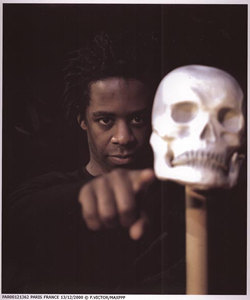
Then when he jumps in Ophelia's grave with Laertes, he achieves
just the right modulation from the magnanimity of his first
lines to the raging anger, provoked by Laertes's violence,
of his last.
And beyond Lester, who can forget the subtlety of Parry's
Gertrude when she finds her conscience?
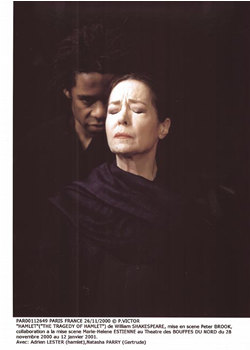
Or the dangerous intelligence that makes Shah's Rosencrantz
a much worthier opponent than we've come to expect, or the
compulsive intellectual daffiness of Myers' Polonius? Or the
subtle musical accompaniment Toshi Tsuchitori provided throughout,
in particular when he came onstage himself to help articulate
the anguish that Shantala Shivalingappa's Ophelia was no longer
capable of expressing in her madness?

|
Another promise Brook made in his Town Hall lecture, however,
was not quite kept. In response to a young woman's challenge
as to why he didn't bring a more unusual, unique play to a
town where Shakespeare is performed with great regularity,
Brook had answered that not only is Hamlet truly unique,
but that it seems to be uniquely responsive to the concerns
of the present moment, judging by the number of productions
recently mounted on stage and screen, or currently planned.
(Indeed, I myself had hoped to host a point of presence for
the Mel Gibson/Robert Downey Jr. production in L.A. earlier
this year—and still hope to whenever the project is revived.)
What special import this play has for us today, however,
still remained obscure by the time these actors' perfect characterizations
had run their course, leaving those of us in the audience
to wonder—what precisely had Brook hoped the interplay
of actor, play, and audience would serve to create in this
production of Hamlet?
We can at least be confident that it was not intended to
be what Hamlet the original, full-length play tends
to communicate: as distilled here, Brook's Hamlet is
less about the limits and power of play acting and scene setting
in the theater of the world than it has become a rather Greek
kind of play—an austere species of ritual reenactment
almost—composed of soliloquies and dialogues mainly,
with a few colloquies thrown in—but no chorus, and no
panoply of minor characters to supply a sense of perspective
on the whole.
Brook's Hamlet is Greek indeed in the Hecuba interlude,
when for some reason he cuts Shakespeare's partly parodic,
partly thematic imitation of the previous generation of dramatic
poets, and instead has Shah intone a impassioned speech in
ancient Greek—a truly impressive demonstration of Brook's
contention that the mere music of a great artist's words,
properly performed, can almost serve to convey their meaning,
especially after Lester's Hamlet surprises us by proving
equally capable of sounding its dactyls and trochees to their
depth.
After his numerous cuts, Brook ends up stitching this Hamlet
together out of all his soliloquies and lectures concerned,
in the main, with the inevitability of death and our difficulty
in facing it. Pretty somber stuff—especially at end,
when those who have died before (Polonius, Ophelia, Rosencrantz)
congregate with those killed in the final scene to follow
psychopomp Horatio into a dawn transposed from the beginning
of the play—only to encounter the spectral fear that
came even before that, in the very first line: "Who's
there?" Who indeed?—who will come to greet us in
that undiscovered country from whose bourn... That is, I suppose,
what we all truly want to know—someday, but probably
not today.
In the meantime, while we're privileged to be penned in this
anteroom here we call the world, we can't help but miss what's
been left out: a few precious if trivial and inconsequential
glimpses out of this play's central darkness into the life
and light that surrounds and will continue without it—the
world of Barnardo and Francisco's watchfulness, Laertes' Paris,
the pomp and circumstance of unnamed men at arms and ladies
in waiting, and even the readiness of Fortinabras and his
large Norwegian army to assume the rule the Danes have lost.
In a way, Lester's is too perfect a portrayal: his Hamlet
is too knowing, too fully in command of his faculties to be
a proper subject of tragedy. When he says there's a special
providence in the fall of a sparrow, it's not in joking defiance
of augury, but a fully reasoned acceptance of it. And when
he finally does get his chance to kill the King, both he and
Claudius are simply too much at peace with their respective
fates (Brook changed or omitted Claudius's final lines here).
Brook's approach falls flatest with Ophelia who, despite
the best the remarkably talented Shivalingappa can do with
her, will never be more than a rather naive if well-meaning
girl, the obedient daughter of Polonius caught up in a situation
so far beyond her capacity to deal with that it drives her—quite
tragically in a production that knows how to make use of the
irony—truly insane.
And in retrospect, that's precisely the problem with Brook's
approach here—dramatic irony is not really a part of
the picture. Characters are imitated to perfection—we
go away feeling we've truly come to know them, in their essence—but
the action they're a part of and which goes beyond them in
its implications, well, it's pretty much left to shift for
itself. For this to be a Tragedy, we need to have the sense
that things could easily have—and should have—turned
out otherwise, if only fate had been kind, not cruel. Otherwise
even a play as great as Hamlet is hardly tragic—just
unfortunate and deeply, achingly sad. There's no chance something
similar might happen to us.
In conclusion all I can say is—I don't quite know what
to make of such a perfectly imperfect adaptation of Hamlet.
Could it be Brook's elegiac farewell to the 20th century,
and all that has died with its passing? Perhaps. You've never
seen these characters so truly delivered. The rest is silence.
|